The Rule of Three: How to Pack Carry-On Only for Dubai
Three tops, two bottoms, one layer. A tested carry-on system for Dubai covering heat, dress codes, liquids, cabin limits and the one item most travellers forget.
10 min read
Why carry-on only makes sense for Dubai
Dubai is one of the easiest cities in the world to visit with just a cabin bag. You skip the baggage belt at Dubai International (DXB), which can take 30 to 60 minutes at busy times, especially in Terminal 3 when several wide-body Emirates flights land together. You can also walk straight to the Dubai Metro Red Line, which has stations at Terminal 1 and Terminal 3. The metro allows luggage, but a big suitcase in the evening rush is hard work for you and for everyone around you.
There is a money reason too. Many fares sold across the Gulf and Levant, including flydubai's lighter fares and most Air Arabia fares, do not include checked baggage. Adding a 20kg bag later can cost more than the difference between fare types. If you book early and travel light, you keep the lowest fare.
Lastly, Dubai makes it easy to fill any gaps. Supermarkets such as Carrefour and Spinneys, pharmacies on almost every block and malls in every district mean anything you forget is rarely more than 15 minutes away. You don't have to pack for every possibility. Pack for the likely ones.

The rule of three: three tops, two bottoms, one layer
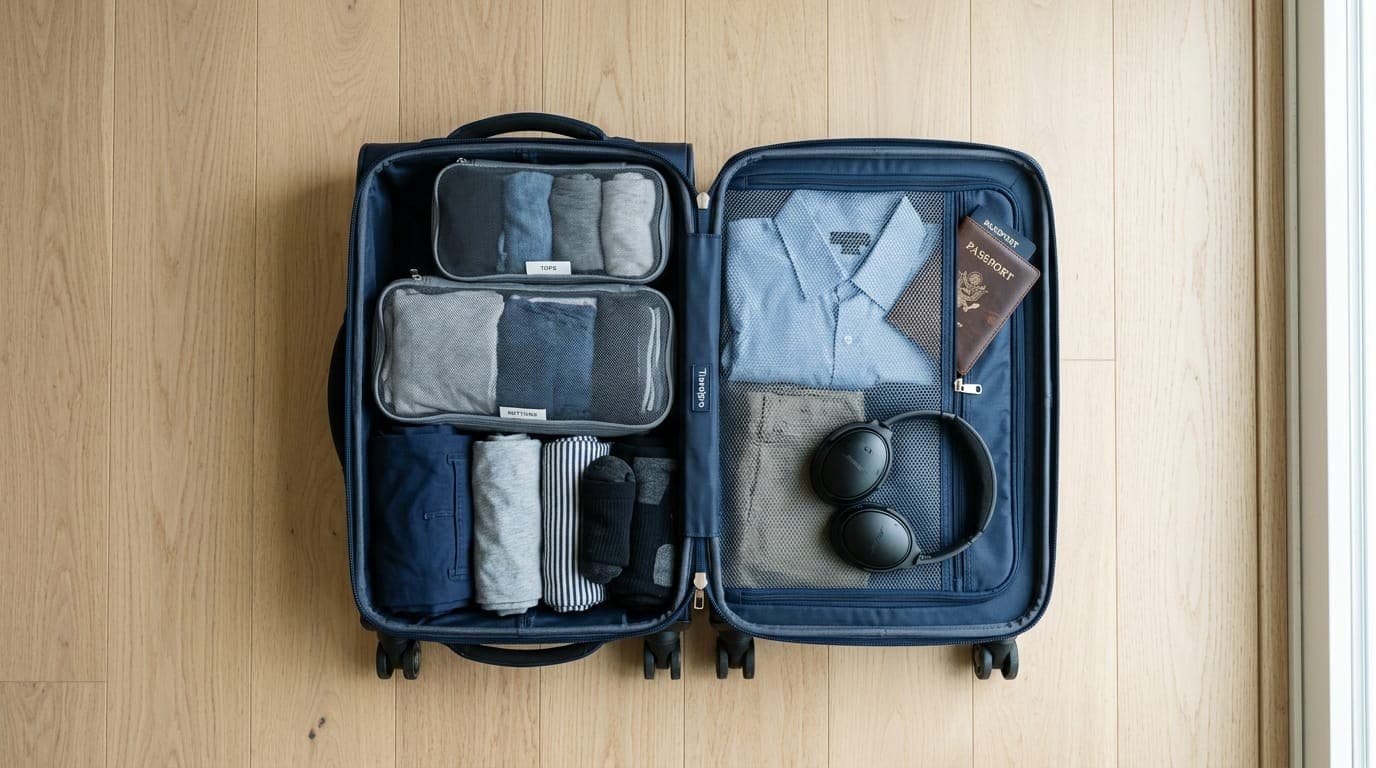
The core of the system is simple. For a trip of up to about a week, pack:
- Three tops. One to wear, one drying, one clean. Choose breathable fabrics like linen, cotton-linen blends or merino-blend tees. Merino sounds wrong for the desert, but lightweight versions (around 150gsm) resist odour, so they can go two or three wears between washes.
- Two bottoms. One pair of lightweight long trousers or a midi/maxi skirt, plus one pair of knee-length shorts or a second, dressier pair of trousers. Every piece should work with all three tops.
- One layer. A thin cardigan, overshirt or light zip jacket. This matters more than you'd expect (see the next section).
On top of that, pack underwear and socks for three to four days, one set of sleepwear, swimwear if your hotel has a pool or you plan to visit Kite Beach or JBR, and one pair of shoes plus sandals. Wear the bulkier pair on the plane.
Insider tip: Stick to one colour family, for example navy, white and sand. Then any top goes with any bottom, and three tops and two bottoms give you six outfits. Patterns are fine on one piece, not on three.
Honest caveat: If you have a formal event, such as a wedding, a business dinner at a DIFC restaurant or a brunch with a dress code, that outfit sits outside the rule. Roll it separately or wear it on the flight. Don't try to make your everyday clothes do double duty.
Dressing for Dubai's climate and customs
Dubai has two very different packing seasons, and one thing stays the same all year: the air conditioning. Metro carriages, malls such as Dubai Mall and Mall of the Emirates, cinemas and taxis are often chilled to around 20–22°C. When it's 43°C outside, the drop is sharp. That's why your one layer matters even in August.
| Summer (June–September) | Winter (December–February) | |
|---|---|---|
| Daytime high | 40–45°C, high humidity on the coast | 23–27°C |
| Evening | 30–35°C | 15–19°C, cooler in the desert |
| Best fabrics | Linen, loose cotton, moisture-wicking blends | Cotton, light knits, jeans are fine |
| The layer | Thin cardigan for malls and metro | Light jacket or fleece for evenings and desert safaris |
| Shoes | Breathable trainers + sandals | Closed shoes + sandals |
October–November and March–April are the shoulder months. Expect roughly 30–36°C by day and pack like summer, with a slightly warmer layer.
Dress norms: Dubai is relaxed by regional standards, but public decency guidelines do apply. Signs in malls ask visitors to cover shoulders and knees, and swimwear belongs at the beach or pool only. If you're taking a day trip to the Sheikh Zayed Grand Mosque in Abu Dhabi, the rules are strict: long loose sleeves and trousers for everyone, plus a headscarf and ankle-length clothing for women. That's another reason your long trousers or maxi skirt earn their place in the bag.
Insider tip: A large lightweight scarf or shawl takes up almost no space. It works as a mosque head covering, a mall cover-up, a sun shield at the beach and a blanket on a cold flight.

Liquids: the 100ml rule and why solids win
At most airports, liquids, aerosols and gels in hand luggage must be in containers of 100ml or less, all fitting in one clear, resealable bag of about one litre. Some airports with newer CT scanners have relaxed this for some passengers. Rules have changed back and forth in the UK and EU in recent years, and your departure airport, DXB and any transit hub may all apply them differently. Pack to the 100ml rule unless you have confirmed otherwise for every airport on your trip. Security staff can confiscate a 150ml bottle even if it's half empty.
The cleanest fix is to go solid, because solid toiletries skip the bag entirely:
- Shampoo and conditioner bars. They last about 50–80 washes and are sold widely in the Gulf at roughly AED 35–70.
- Solid or stick deodorant. Sticks generally count as solids. Roll-ons and sprays don't.
- Sunscreen sticks. These are useful for face and ears. For full-body cover, see below.
- Toothpaste tablets, or a travel-size tube inside your liquids bag.
- Bar soap or cleansing bars in a small tin.
- Solid perfume, or a 10ml atomiser.
Anything that stays liquid, like contact lens solution or serums, goes in the one-litre bag. Keep that bag at the top of your carry-on so you can pull it out quickly at security.
Honest caveat on sunscreen: In summer the UV index in Dubai regularly reaches 10–11+. A 100ml tube won't last a week of beach days. Buy a full-size SPF 50 on arrival instead: expect roughly AED 45–100 (about USD 12–27) at pharmacies and Carrefour. Leave it behind or finish it before you fly home.
Duty-free trap: If you buy perfume or oud oil at Dubai Duty Free and have a connecting flight elsewhere, keep it in the sealed tamper-evident bag with the receipt inside. Don't open it until your final destination, or it may be taken at transfer security.
Know your cabin allowance before you pack
The rule of three only works if your bag meets the airline's size and weight limits. These are typical economy allowances on carriers serving Dubai. Always check your own booking, because limits vary by fare type and route.
- Emirates: one cabin bag up to 7kg, max 55 × 38 × 20cm, in Economy. Business and First allow more.
- flydubai: a 7kg cabin bag on all fare types, similar dimensions.
- Air Arabia: typically one main cabin bag plus a small personal item, with a combined weight limit. Check the current total for your fare.
- Etihad, Saudia, Royal Jordanian, Qatar Airways: generally 7kg for economy cabin bags, with varying rules on extra personal items.
The 7kg reality: A carry-on wheeled case can weigh 2–3kg empty. That leaves only 4–5kg for your things. A soft backpack of 30–40 litres usually weighs under 1.5kg, which is why experienced light packers prefer them. Weigh your packed bag at home with a luggage scale (about AED 20–40 online). Low-cost carriers in the region do weigh bags at the gate, and gate fees for an over-limit bag can easily reach AED 150–300 or more.
Insider tip: Wear your heaviest items on the flight: your layer, your trainers and your long trousers. Pockets don't count toward the limit.

Tech, medicines and items that need care in the UAE
Power banks: Lithium power banks must travel in the cabin, never in checked luggage, and are usually limited to 100Wh (roughly 27,000mAh) without airline approval. Since October 2025, Emirates and flydubai have banned using or charging power banks on board. You can still carry one, but charge your phone before you board. Other regional airlines have brought in similar restrictions, so check before you fly.
Plugs: The UAE uses the UK-style three-pin Type G socket at 220–240V. Travellers from Saudi Arabia, Kuwait, Bahrain, Qatar and Oman will usually find their plugs already fit. Most visitors from Jordan, Lebanon and Egypt need an adaptor. One compact multi-USB charger with a Type G adaptor replaces three separate bricks.
Medicines: This is the one area where you shouldn't improvise. The UAE strictly controls some medicines that are routine elsewhere, including some painkillers containing codeine, certain ADHD medications, strong sleeping pills and some anxiety medications.
- Carry medicines in their original packaging with a copy of your prescription or a doctor's letter.
- Bring only a reasonable personal quantity, generally up to three months' supply.
- For controlled or narcotic medicines, check the UAE Ministry of Health and Prevention (MOHAP) guidance and apply for advance approval through its online service before you travel.
E-cigarettes and CBD: Vapes are allowed in the cabin but not in checked bags, and you can't use them on board. CBD products, including some sold legally elsewhere, can cause serious problems at UAE customs. Leave them at home.
The forgotten item: a collapsible water bottle
The item almost everyone leaves out is a collapsible or empty reusable water bottle. It goes through security empty, rolls or folds down to the size of a phone, and pays for itself on the first day.
Why it matters in Dubai:
- At the airport: A small bottle of water airside at many airports costs about AED 8–15 (USD 2–4). DXB has drinking water fountains past security, so fill up before you board. Cabin air is very dry, and you'll arrive in better shape if you've been drinking water.
- In the city: The Dubai Can sustainability initiative has installed public water refill stations in popular outdoor areas, including Kite Beach, JBR, Dubai Marina and Al Seef, and more have been added since the scheme launched in 2022. They're free.
- In the heat: In summer you can easily need 3–4 litres a day if you're outdoors. Supermarket bottled water is cheap, about AED 1.5–3 for 1.5 litres, but refilling saves time and plastic.
Dubai's tap water meets international standards set by DEWA, the city's utility. Many residents still drink bottled or filtered water, mainly because of the taste and old building pipes. Using tap water for brushing teeth is fine. For drinking, refill stations, hotel dispensers and filtered water are the popular choices.
Insider tip: Get a bottle with an insulated sleeve or a silicone body that can go in the hotel freezer. In July, cold water stays cold for maybe 20 minutes outdoors, and every extra minute helps.
Laundry and restocking on the ground
Three tops only works if you can wash them. You have three options in Dubai:
- Sink wash. Pack a small bar of laundry soap or a few detergent sheets, which are solid and skip the liquids bag. In a hotel room with the AC running, linen and merino dry overnight.
- Local laundries. Neighbourhoods such as Al Karama, Bur Dubai, Deira and Al Barsha have many small laundries. Expect roughly AED 3–8 per item for wash-and-iron, often with same-day or next-day return. Many will collect from your hotel or apartment.
- Hotel laundry. This is convenient but typically AED 15–40 per shirt at mid-range and luxury hotels. Use it only for your formal piece.
Restocking: If you forget something, go to a Carrefour or Lulu hypermarket for basics, or to Boots and local pharmacy chains for toiletries. Dubai Mall and Mall of the Emirates have every mainstream clothing brand. For cheaper basics, Karama's shops and the textile area near the Bur Dubai souk are better value.
Final carry-on checklist:
- 3 tops, 2 bottoms, 1 layer, 1 scarf
- Underwear and socks for 3–4 days, sleepwear, swimwear
- 1 pair of shoes worn + 1 pair of sandals packed
- Solid toiletries + one 1-litre liquids bag
- Medicines in original packaging with prescription
- Phone, Type G adaptor, charger, power bank (under 100Wh)
- Passport, visa or eligibility confirmation, printed or offline booking details
- Empty collapsible water bottle
Packed this way, most travellers come in well under 7kg. There's room for a box of dates or a small bottle of oud on the way home, as long as you remember the duty-free sealed bag.
Is 7kg really enough for a week in Dubai?
Yes, for most leisure trips. Dubai's warm climate means light clothes, and the rule of three (three tops, two bottoms, one layer) plus solid toiletries usually weighs 4–5kg. Use a light backpack rather than a heavy wheeled case, wear your bulkiest items on the plane, and use a local laundry in Karama or Bur Dubai halfway through.
Do I still need to follow the 100ml liquids rule when flying to or from Dubai?
Assume yes. Some airports with new CT scanners have relaxed liquid limits, but rules differ between terminals and countries, and transit airports may be stricter. Keep liquids at 100ml or less in one clear one-litre bag unless you have confirmed the rules for every airport on your trip. Solid toiletries avoid the problem entirely.
What should I wear in Dubai malls and at mosques?
In malls, cover your shoulders and knees. Signs at entrances ask visitors to dress modestly, and swimwear is for beaches and pools only. Mosques are stricter: long loose sleeves and trousers for everyone, and women need a headscarf and ankle-length clothing. A large lightweight scarf in your bag covers most situations.
Can I bring my prescription medicines into the UAE?
Usually, but prepare. Carry medicines in their original packaging with your prescription or a doctor's letter, and bring only a reasonable personal supply. Some medicines, such as codeine-based painkillers and certain ADHD or sleep medications, are controlled in the UAE and need advance approval through the Ministry of Health and Prevention's online service before you travel.