Baku in 2 Days: Old City, Gobustan and the Mud Volcanoes
A practical 48-hour Baku plan: the walled Old City and Maiden Tower, the seaside Boulevard, Gobustan's rock art and mud volcanoes, and tea in a çayxana.
9 min read
Why Baku works for a 48-hour trip
Baku is one of the easiest short breaks from the Gulf. Nonstop flights from Dubai and Sharjah take about 3 hours. The city is compact, and the best sights are either walkable or within an hour's drive. With two full days you can see the UNESCO-listed walled Old City, walk the Caspian seafront, and spend a day south of the city at Gobustan's prehistoric rock carvings and the mud volcanoes nearby.
This plan assumes you land the evening before Day 1, or early that morning, and stay somewhere central. Sahil, Fountains Square/Nizami Street and the area around Icherisheher metro all put the Old City and the Boulevard within a 5–15 minute walk.
Money basics (2026): the Azerbaijani manat (AZN) is effectively pegged at about 1.70 to the US dollar, so 1 AZN ≈ 2.15–2.20 AED. In this guide, AED figures are rounded. Cards work in most hotels, restaurants and larger shops. Keep some cash in small notes for taxis to the mud volcanoes, çayxanas and Old City souvenir stalls.

Before you go: flights, visas and getting into the city
Flights. flydubai and AZAL (Azerbaijan Airlines) fly Dubai–Baku daily, and Air Arabia flies from Sharjah. Return economy fares usually run AED 900–1,800. They climb higher around Eid, the UAE summer holidays and big Baku events. Booking 6–8 weeks ahead usually gets the better fares.
Visas. Rules depend on your passport, and they change, so check the official ASAN e-visa portal (evisa.gov.az) before you book.
- GCC nationals have generally been eligible for visa on arrival or visa-free entry.
- Most other nationalities, including many Gulf-based expats, use the e-visa. The standard version costs roughly USD 25–30 (about AED 95–110) and takes around 3 working days. An urgent option costs more.
- Only use the official site. Look-alike agency sites charge double.
From Heydar Aliyev International Airport (GYD):
| Option | Cost (approx.) | Time to centre | Notes |
|---|---|---|---|
| Aeroexpress bus H1 | ~1.50 AZN (~AED 3) | 40–60 min | 24/7, ends at 28 May metro station; you need a BakuCard |
| Bolt / app taxi | 20–35 AZN (~AED 45–75) | 25–40 min | Fixed upfront price; the easiest option at night |
| Airport taxi rank | 30–50 AZN (~AED 65–110) | 25–40 min | Agree the fare before you get in |
BakuCard is the rechargeable transport card used on metro and city buses. Buy it from machines at the airport or any metro station. The card costs about 2 AZN plus whatever credit you load. Metro fares are well under 1 AZN per ride, and newer gates also accept contactless bank cards.
Day 1 morning: Icherisheher and the Maiden Tower
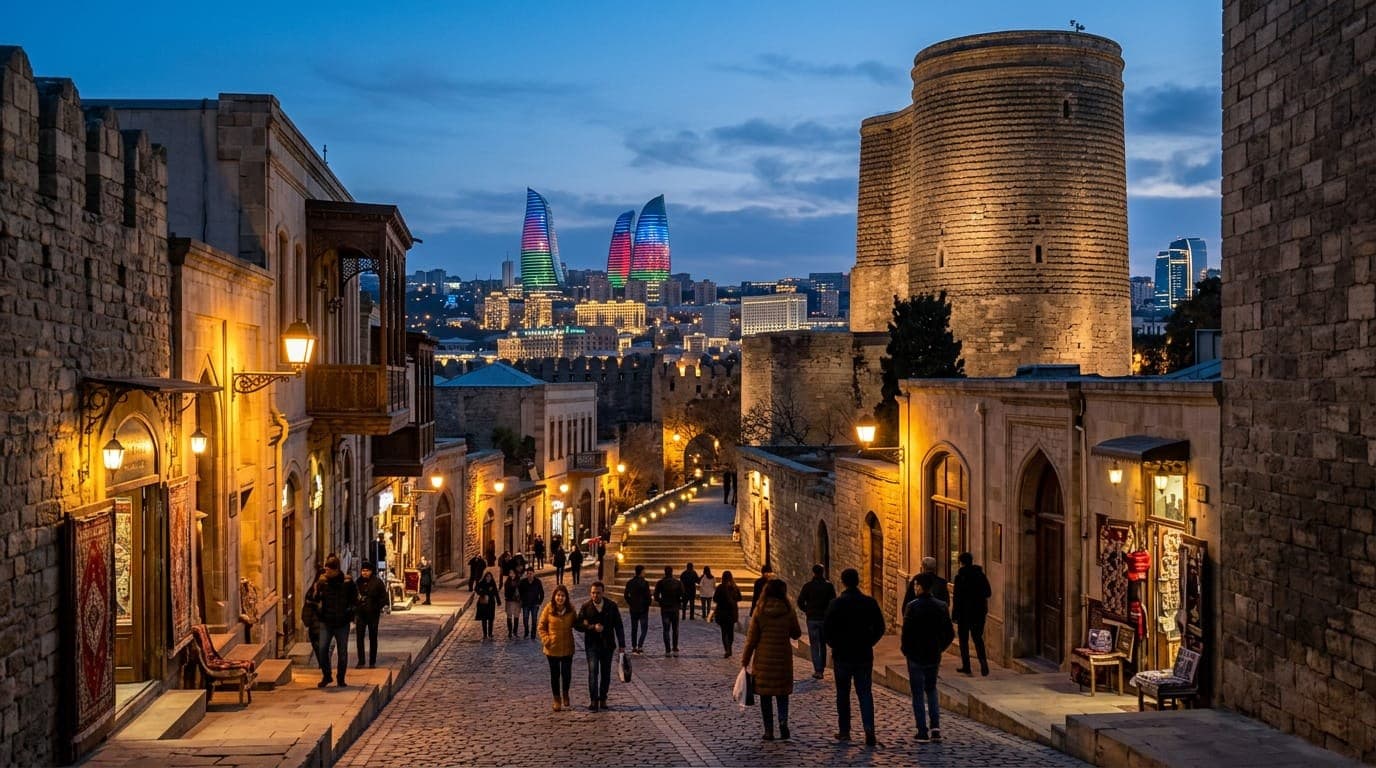
Start early, ideally by 9:00–9:30, before tour groups arrive. Icherisheher (the Inner City) is Baku's walled medieval core and a UNESCO World Heritage Site since 2000. It's small, about 22 hectares, but hilly and cobbled, so wear proper shoes.
Enter through the Double Gates (Qoşa Qala) facing the Baku Philharmonic side, or from Icherisheher metro. A sensible loop:
- Maiden Tower (Qız Qalası), the 12th-century (possibly older) stone tower that has become Baku's symbol. Inside are small exhibits on each level. The rooftop gives a good view over the Old City, the Boulevard and the Flame Towers. Entry for foreigners is around 15 AZN (~AED 32). Allow 45 minutes.
- Palace of the Shirvanshahs, a 15th-century complex with a mausoleum, a mosque and a courtyard bathhouse. Entry is also around 15 AZN. Allow 60 minutes. It's the best-explained site in the Old City.
- The lanes in between: the Multani and Bukhara caravanserais, the carpet and copper stalls near the Maiden Tower, and the quieter residential alleys on the upper side, where locals still live.
Insider tips
- Opening hours are generally about 10:00–18:00 and can be shorter in winter. Check the Icherisheher administration site for current ticket prices, because foreigner rates have risen in recent years.
- Carpet sellers are persistent but not aggressive. If you're seriously buying, ask for an export certificate. Older or handmade carpets need paperwork to leave the country.
- Accept an unofficial guide only if you've agreed the price in advance.

Day 1 afternoon and evening: Fountains Square, the Boulevard and the Flame Towers
Leave the Old City through the gates near Fountains Square. This is the city's social hub, with Nizami Street (the main pedestrian shopping street) running off it. It's a good lunch stop. Look for qutab (thin stuffed flatbreads, about 1–3 AZN each), dolma, or a proper plov. A sit-down lunch in the centre typically costs 20–40 AZN per person (~AED 45–85).
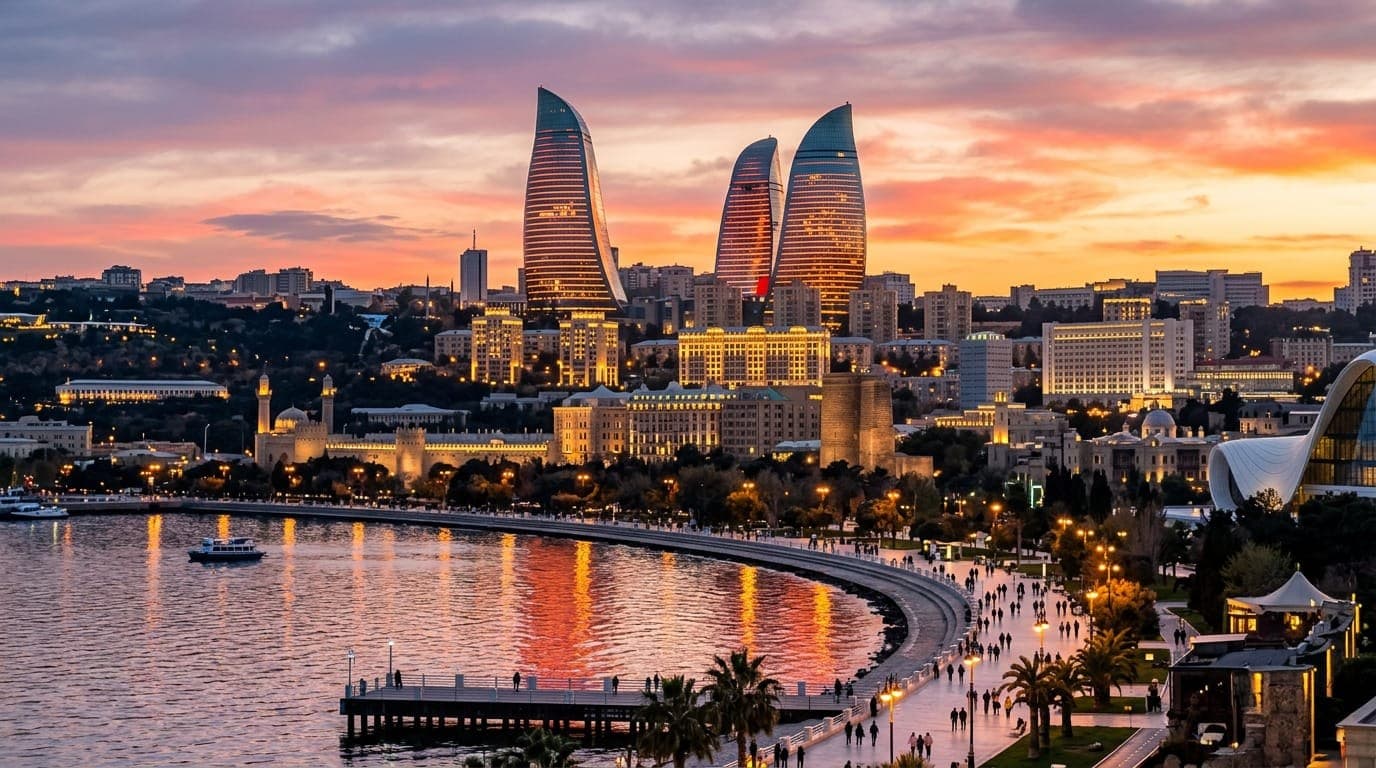
Then head down to the Boulevard (Dənizkənarı Milli Park), the seafront promenade that has run along the Caspian since 1909 and now stretches for kilometres. Highlights, west to east:
- Azerbaijan Carpet Museum, in the rolled-carpet-shaped building. It's worth an hour even if you're not into textiles. Entry is roughly 10 AZN.
- Little Venice (small canals with boat rides) and the older central stretch, full of families in the evening.
- Baku Crystal Hall and National Flag Square at the far end if you're keen to walk. Otherwise take a Bolt.
Sunset plan: go up to Highland Park (Dağüstü Park) either by the funicular from the Boulevard end near Neftchilar Avenue (about 1 AZN) or by walking the steps. The Martyrs' Lane memorial is there, and the viewpoint looks over the whole bay. After dark, the Flame Towers light up with LED displays. The best angle is from the Boulevard itself.
Honest caveat: Baku is called the "City of Winds" for a reason. From autumn to spring the khazri wind off the Caspian can make evening Boulevard walks bitterly cold, so bring a windproof layer even if the day was mild.
Day 2: Gobustan rock art and the mud volcanoes
Gobustan National Park (UNESCO, 2007) is about 60 km south-west of Baku, roughly an hour's drive along the Baku–Salyan highway. It protects over 6,000 rock engravings, some dating back more than 10,000 years: hunters, boats, dancers, aurochs. Start at the modern museum at the base of the hill for context, then walk the marked trail through the boulders. Entry is around 10 AZN (~AED 22) and includes the museum. Allow 1.5–2 hours in total.
The mud volcanoes are a separate site, about 10–15 km from the museum, on dirt tracks near the village of Alat. Azerbaijan has the largest concentration of mud volcanoes in the world. The ones visitors reach are small, cold, gurgling cones of grey mud that burp methane. It's strange rather than dramatic, and a lot of fun.
How the mud volcano leg works:
- Normal taxis and many rental cars won't take the rough track. Old Ladas wait near Gobustan village and the museum turn-off to shuttle visitors up and back, usually 30–50 AZN per car (~AED 65–110) including waiting time. Agree the price before you set off.
- After heavy rain the track becomes impassable and drivers will refuse. That's a safety call, not a scam.
- Don't walk right up to active vents, and keep mud off your camera. It dries like cement.
Bring water, sunscreen and a hat. There's almost no shade at either site, and summer highs regularly reach the mid-30s °C.

Tour, taxi or public transport? Choosing how to do Day 2
| Option | Typical cost | Pros | Cons |
|---|---|---|---|
| Shared group tour | 35–70 AZN pp (~AED 75–150) | Cheapest hassle-free option; often adds Bibi-Heybat Mosque, plus Ateshgah and Yanar Dag on the Absheron Peninsula | Fixed pace, large groups, short stops |
| Private driver / day taxi | 100–180 AZN per car (~AED 215–390) | Your own timing; good value split between 3–4 people | Negotiate clearly: which sites, how many hours, whether the mud-volcano Lada is included |
| Public bus + local Lada | ~10–15 AZN pp plus the Lada fare | Very cheap, authentic | Slow; buses leave from the southern suburbs (the Lökbatan area) and need a transfer; hard without Russian or Azerbaijani |
Recommendation: for most visitors, a private driver or a small-group tour that combines Gobustan, the mud volcanoes and Bibi-Heybat Mosque on the way back is the best use of limited time. Leave around 9:00 and you'll be back in the city by 15:00–16:00, with time to rest before dinner.
If you want the fire sites (Yanar Dag burning hillside and the Ateshgah fire temple) as well, they're on the opposite side of Baku, on the Absheron Peninsula. Combining everything makes an 8–9 hour day. It's doable, but tiring.
Day 2 evening: dinner and tea in a çayxana
Finish the trip Azerbaijani-style. A çayxana (teahouse) is where people spend the evening talking over black tea in pear-shaped armudu glasses. Traditionally the tea comes with lemon, sugar cubes, and small dishes of mürəbbə (fruit preserves such as cherry, quince, fig, or even walnut). You sip the tea through the jam or a sugar cube rather than stirring it in.
Where to find them:
- Inside Icherisheher: atmospheric courtyard teahouses in the old caravanserais and lanes. They're touristy, but lovely at night.
- Along the Boulevard: casual outdoor spots popular with families.
- Neighbourhood çayxanas in areas like Nasimi and around Nizami metro: cheaper, more local, and traditionally more male-dominated. The tourist-facing ones are completely comfortable for women and families.
Typical prices: a tea set (pot, jams and sweets) for two costs 8–25 AZN (~AED 17–55) depending on how central it is. A full dinner of plov, lyulya kebab, dushbara (tiny dumplings in broth) and salads runs 30–60 AZN per person (~AED 65–130) in a mid-range restaurant.
Worth knowing: many restaurants add a 10% service charge, so check the bill before tipping extra. Halal food is the norm, but alcohol is widely available. If that matters to you, ask.
Practical tips, costs and honest caveats
Rough 2-day budget per person (excluding flights and hotel):
- Budget: 120–180 AZN (~AED 260–390), using a group tour, local food and the metro
- Mid-range: 250–400 AZN (~AED 540–870), with a private driver shared by two, sit-down meals and all the paid sites
Hotels: central mid-range hotels usually cost 120–250 AZN a night (~AED 260–540). Prices jump sharply during the Formula 1 Azerbaijan Grand Prix weekend (usually September) and major conferences, and parts of the Boulevard and Old City perimeter close for the street circuit.
Best time to visit: April–June and September–October bring mild temperatures (18–28 °C). July–August is hot and humid. Winters are grey, windy and cold, though Old City sightseeing still works.
Caveats:
- Street-hailed taxis often overcharge foreigners. Use Bolt or agree the fare first.
- English is common in hotels and central restaurants, less so with drivers and in çayxanas. A translation app helps.
- Avoid political discussions and photographing military or government buildings.
- Since 2024, some politically sensitive stamps and recent Armenia travel histories have caused questions at entry. Most travellers have no issues, but carry your hotel booking and return ticket.
Getting around the centre: most of this itinerary is walkable. For longer hops, the metro is fast, clean and cheap, and stations such as Icherisheher, Sahil and 28 May cover the core.
Are two days enough to see Baku?
Two days covers the essentials: the Old City, the Maiden Tower, the Shirvanshahs' Palace, the Boulevard, Highland Park, and a half-day trip to Gobustan and the mud volcanoes. You won't have time for the Absheron fire sites or the Heydar Aliyev Center at a relaxed pace. Add a third day if you want those, or a trip into the mountains.
How much does a Gobustan and mud volcano trip cost from Baku?
Shared group tours usually cost 35–70 AZN per person (about AED 75–150). A private driver for the day runs roughly 100–180 AZN per car. If you go independently, budget around 10 AZN for Gobustan entry plus 30–50 AZN per car for the Lada that shuttles visitors up the rough track to the volcanoes.
Can I use UAE dirhams or cards in Baku?
Dirhams aren't accepted in shops, but exchange offices in central Baku and at the airport change AED, USD and EUR easily. Visa and Mastercard work in hotels, most restaurants, malls and Bolt. Carry cash in manat for mud-volcano drivers, small çayxanas, Old City stalls and public toilets. ATMs are plentiful throughout the centre.
Is Baku suitable for families and Muslim travellers from the Gulf?
Yes. Baku is a Muslim-majority, family-friendly city. Halal food is standard, and mosques such as Bibi-Heybat and Taza Pir are easy to visit. The Boulevard and its parks are full of families in the evenings. Alcohol is sold openly and dress codes are relaxed, but modest dress is never out of place. Street crime is low, though taxi overcharging is common.