Day Trips from Bangkok by Train, Boat and Bus: Ayutthaya, Kanchanaburi and More
How to reach Ayutthaya, Kanchanaburi, Maeklong, Koh Kret and Bang Krachao on public transport, with realistic timings, fares in THB and AED, and an easy weekly plan.
10 min read
Why Leave Bangkok for a Day
Bangkok rewards slow exploration, but after a few days of traffic, malls and humidity, the places one to three hours away show a different Thailand. You can see ruined royal capitals, wartime history, riverside villages and pockets of jungle-like green. You can reach almost all of them for less than a city taxi ride across town.
Public transport is the honest way to do these trips. Thailand's state railway still runs cheap third-class trains with open windows and food vendors walking the aisles. Long-distance and commuter routes now share the hub at Krung Thep Aphiwat Central Terminal (formerly Bang Sue Grand), and some services still use Hua Lamphong. Express boats, minivans and air-conditioned buses cover the rest. A full day out typically costs around 300–800 THB (roughly AED 35–90) including transport, entry fees and lunch. A private driver costs several times that.
The best window is November to February. Mornings are cooler, rain is rare and walking around open-air ruins at midday is bearable. From March to May, temperatures regularly pass 35°C, so start at dawn. From June to October, expect afternoon downpours and occasional flooding, especially along the river.
This guide skips the city-centre temples and focuses on five escapes:
- Ayutthaya
- Kanchanaburi
- Maeklong and Amphawa
- Koh Kret
- Bang Krachao
Each is described with the real logistics.
Stations, Terminals and Tickets: The Short Version
Most planning headaches come from leaving from the wrong place. Bangkok has several departure points, and each serves different destinations.
- Krung Thep Aphiwat Central Terminal (MRT Blue Line Bang Sue, or SRT Red Line): most northern and northeastern trains, including the faster services to Ayutthaya.
- Hua Lamphong (MRT Hua Lamphong): some ordinary and commuter trains still run from here, including slow, cheap services towards Ayutthaya. Check before you go, because the split keeps changing.
- Thonburi station (Bangkok Noi, reachable by Chao Phraya Express to Thonburi Railway pier): trains to Kanchanaburi and the River Kwai.
- Wongwian Yai station (about 10 minutes' walk from BTS Wongwian Yai): the little Maeklong line towards Mahachai.
- Sai Tai Mai, the Southern Bus Terminal: buses and minivans to Kanchanaburi, Maeklong and Amphawa.
- Mo Chit, the Northern Bus Terminal: minivans to Ayutthaya.
You can book long-distance trains on the SRT D-Ticket website or app. Third-class seats on ordinary and commuter trains are sold only at the station on the day, typically for 15–50 THB, and they rarely sell out. Minivans fill up first come, first served; arrive 20–30 minutes early on weekends.
For the city legs, a Rabbit card works on the BTS. The MRT accepts contactless Visa and Mastercard. Download Grab or Bolt for the short hops between a station and a pier, which typically cost 60–150 THB.
Ayutthaya: The Old Capital by Train and Bicycle
Ayutthaya was the Siamese capital for over 400 years until the Burmese sacked it in 1767. Its brick prang towers and headless Buddhas make it the most rewarding day trip from Bangkok.
Getting there: Trains run frequently throughout the day.
- A third-class ordinary train from Hua Lamphong or Krung Thep Aphiwat costs around 15–20 THB (about AED 2) and takes 1.5–2 hours.
- Express and special express trains are faster but cost around 100–350 THB, depending on class.
- Minivans from Mo Chit take about 1.5 hours, depending on traffic, for around 60–80 THB.
On arrival: From Ayutthaya station, walk straight ahead to the river. A small ferry takes you across for a few baht to the island where the ruins are. Bicycle rental shops line the road opposite the jetty, typically 50–100 THB a day. Tuk-tuks offer hourly tours at around 200–300 THB per hour; agree the route and price before you get in.
Route: Start with:
- Wat Mahathat, home of the Buddha head entwined in tree roots.
- Wat Ratchaburana next door.
- Wat Phra Si Sanphet, with its three restored chedis.
Finish late afternoon at Wat Chaiwatthanaram, across the river, at sunset. Entry is typically around 50 THB per temple, and a combined ticket is often available.
Eat: Ayutthaya is famous for boat noodles (kuay teow reua) served in small bowls, and roti sai mai, thin flatbread wrapped around strands of spun sugar, sold near the hospital on U Thong Road.
Kanchanaburi: The River Kwai on the Old Line
Kanchanaburi tells one of the darkest stories of the Second World War. Allied prisoners and Asian labourers were forced to build the Thailand–Burma Death Railway, and tens of thousands died. Today it is a calm riverside town, and the journey there is part of the experience.
Getting there: Slow trains leave Thonburi station, typically early morning and early afternoon, and take about 3 hours. Foreign visitors usually pay a flat fare of around 100 THB (about AED 11). Sit on the right side for countryside views. Buses and minivans from Sai Tai Mai take 2–2.5 hours for around 100–130 THB. They are faster and more frequent, so they are a better option for the return.
What to see:
- Kanchanaburi War Cemetery sits opposite the station. Entry is free, and it is impeccably kept.
- The Thailand–Burma Railway Centre next door is the best museum on the subject, typically around 150–200 THB.
- Continue to the Bridge on the River Kwai, about 2 km north. You can walk across it between trains.
Train extension: If you take the morning train, you can stay on beyond Kanchanaburi towards Nam Tok. This lets you cross the wooden Wang Pho viaduct, built along a cliff. A full Nam Tok round trip makes for a very long day, though. Most day-trippers ride just one stretch, then return by bus.
Eat: Riverside restaurants along the bridge serve freshwater fish such as pla tub tim (red tilapia), steamed with lime and chilli.
Maeklong Railway Market and Amphawa: Trains, Markets and Fireflies
This trip combines two very different experiences.
Maeklong Railway Market: Vendors pull back their awnings minutes before the train rumbles through, then push their stalls back over the tracks the moment it passes.
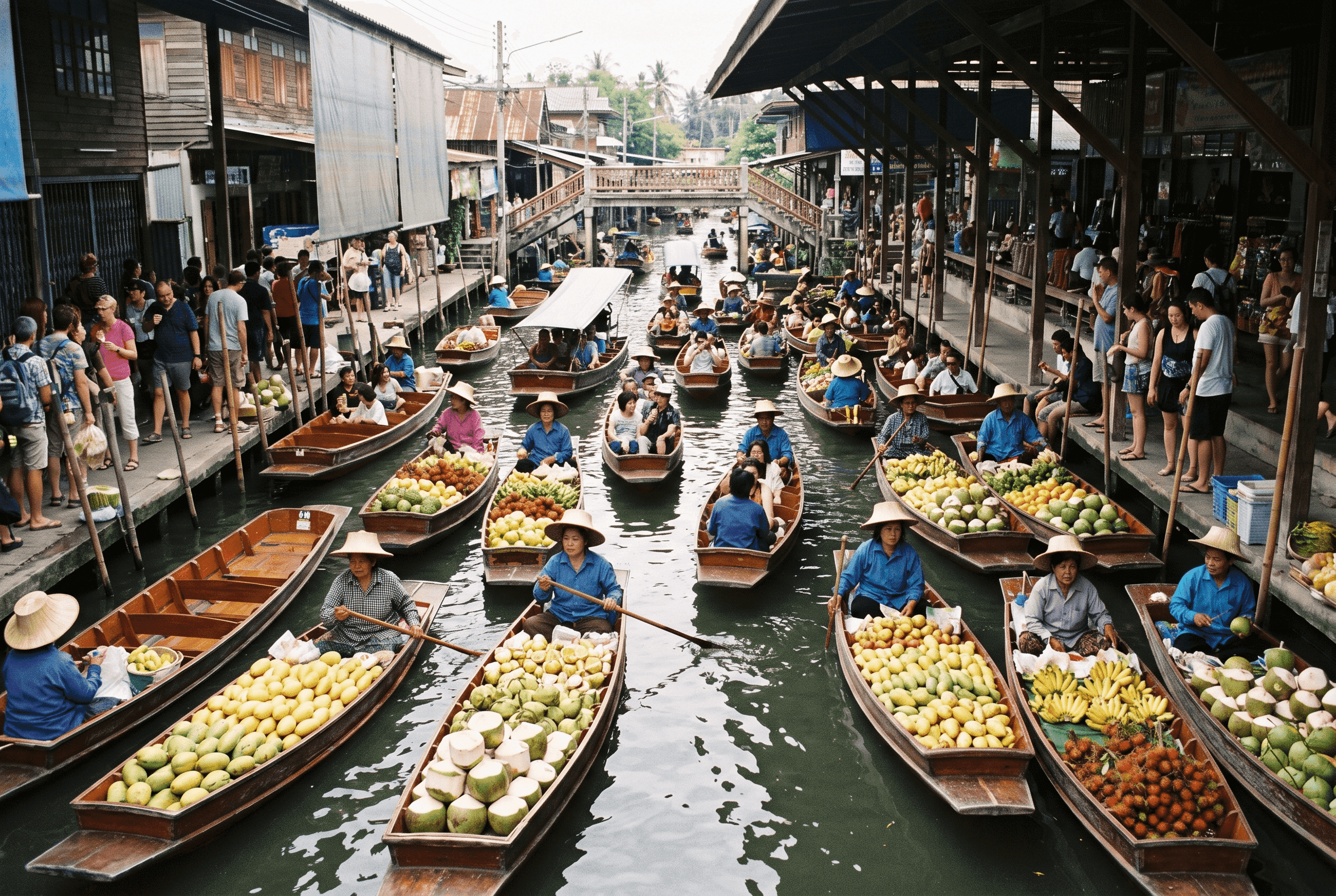
Amphawa: A canal town with a real local floating market. It runs mainly on Friday to Sunday afternoons and evenings.
By train: The adventurous route from Wongwian Yai runs about an hour to Mahachai (around 10 THB). There you take a short ferry across the Tha Chin River (a few baht) to Ban Laem, then another train of about an hour to Maeklong. Services are infrequent, only a handful per day, and sections sometimes close for engineering works. Check the timetable at Wongwian Yai the day before.
By minivan: The reliable option. Minivans from Sai Tai Mai reach Maeklong in about 1.5 hours for around 70–100 THB. Trains pass through the market several times a day, typically late morning and mid-afternoon. Plan your arrival accordingly and stand behind the vendors when the bell rings.
On to Amphawa: Blue songthaews (shared pickups) run from Maeklong to Amphawa in about 15 minutes for around 10–15 THB. Eat grilled river prawns and squid from boats moored along the canal.
Evening: At dusk, longtail boats offer firefly tours for around 60–100 THB per person. Check the last minivan back to Bangkok, usually in the evening, before you commit.
Koh Kret and Bang Krachao: Half-Day Green Escapes
If you only have a free morning, two places within Greater Bangkok feel far from the city.
Koh Kret is an island in the Chao Phraya, home to a Mon community known for terracotta pottery.
- Getting there: Take the orange-flag Chao Phraya Express north to Nonthaburi pier, about 45–60 minutes for around 16–20 THB. From there, take a taxi or Grab to Wat Sanam Nuea pier (around 100–150 THB). A cross-river boat takes you to the island for a few baht.
- On the island: A paved loop of about 6 km circles it. Rent a bicycle for around 40–60 THB.
- When to go: Weekends are livelier, with food stalls selling tod mun (fish cakes), khao chae (rice in jasmine water) and fried flowers. Weekdays are quiet, and some workshops close.
Bang Krachao is often called Bangkok's green lung. It is a loop of the river covered in mangroves, plantations and raised cycle paths.
- Getting there: Take the MRT to Khlong Toei, then a short taxi to Wat Khlong Toei Nok pier. Longtail boats cross for around 5–10 THB, and bike shops wait on the other side for around 60–100 THB a day.
- On the island: Ride to Sri Nakhon Khuean Khan Park, which has an observation tower (free entry).
- When to go: On weekends, add the Bang Nam Phueng floating market for lunch.
How to Fit Them Into a Week: A Sample Plan and Insider Tips
These trips work best spread across a week. Plan around market days and the heat.
- Day 1 (Monday): Ayutthaya. Take a morning train before 08:00, cycle the island and stay for sunset at Wat Chaiwatthanaram. Return by minivan or a late train.
- Day 2 (Tuesday): A city rest day, or Bang Krachao in the morning, before it gets hot.
- Day 3 (Wednesday): Kanchanaburi. Ride the morning train from Thonburi and return by bus from the terminal next to the market.
- Day 4 (Thursday): A city day.
- Day 5 (Saturday): Maeklong in the late morning, then Amphawa for the afternoon market and fireflies.
- Day 6 (Sunday): Koh Kret in the morning, then Chatuchak Weekend Market in the afternoon on the MRT.
Tips:
- Avoid Bangkok's evening rush (16:30–19:30) when you return by minivan. A train back is often faster.
- Carry small notes. Ferries, songthaews and stalls rarely accept 1,000 THB notes.
- Dress for temples: cover your shoulders and knees. Ayutthaya's ruins are active religious sites.
- Download offline maps. Station signage outside Bangkok is often in Thai only.
- Third class is not air-conditioned. In the cool season it is pleasant; from March to May, upgrade or take the bus.
- Families: Amphawa and Koh Kret work best with children. Kanchanaburi's museums suit older children and teenagers.
Practical Basics: Arrival, Getting Around, Money and Safety
Arriving at BKK: Suvarnabhumi Airport's Airport Rail Link runs to Phaya Thai, about 25 minutes for around 15–45 THB. Change there to the BTS. A metered taxi to central Bangkok typically costs around 300–450 THB, plus expressway tolls and a 50 THB airport surcharge. Flights from Dubai, Abu Dhabi, Doha and other Gulf hubs take about 6 hours.
Getting around: Base yourself near a BTS or MRT station, ideally Silom, Sukhumvit (Asok, Phrom Phong) or Riverside, because it makes early departures easy. Allow 45–60 minutes to reach Thonburi or Sai Tai Mai from Sukhumvit.
Money: 1 AED is typically around 9 THB, but check the current rate. Exchange booths such as SuperRich give better rates than airport counters. Thai ATMs charge foreign cards around 220 THB per withdrawal, so take out larger amounts. Day-trip towns are largely cash-based. Budget around 500–1,000 THB (AED 55–110) per person per day trip, including food.
Safety:
- Scams: Thailand is generally safe, but watch for classic tricks. A stranger may say a temple or station is closed and offer a tuk-tuk elsewhere. Minivan touts may also push you onto overpriced private transfers.
- The tracks: At Maeklong, stay behind the vendors' line when the train approaches.
- The heat: Drink plenty of water. Sun and dehydration cause more problems than crime does.
- Halal food: Halal options are easy to find in Bangkok. In Ayutthaya, look for Muslim-run restaurants near Pa Thon Road.
Read more: Bangkok · 3 Days in Bangkok: A Realistic Itinerary of Temples, River Boats and Street Food
Can I do Ayutthaya and the floating markets in one day?
Not realistically. They are in opposite directions from Bangkok: Ayutthaya is to the north and Maeklong and Amphawa are to the southwest. Combining them by public transport means spending most of the day in traffic. Treat each as its own day out.
Should I book trains in advance?
Third-class seats on ordinary trains are sold only at the station and rarely sell out. Book express and special express trains to Ayutthaya on the SRT D-Ticket site a few days ahead, especially on Thai public holidays and from December to January.
Is the Maeklong train still running?
The market is open daily, but the train schedule changes and parts of the line sometimes close for works. Check the timetable at Wongwian Yai station or ask your hotel the day before. If the train is not running, take a minivan from Sai Tai Mai.
How much should I budget per day trip?
Allow around 500–1,000 THB (AED 55–110) per person. This covers return transport, entry fees, bicycle rental and two meals. Kanchanaburi with museums is at the higher end; Koh Kret and Bang Krachao can cost under 300 THB.